
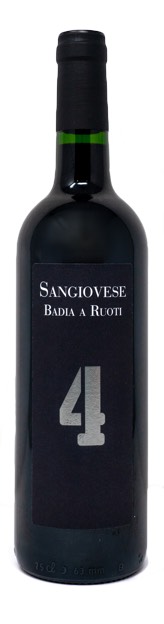
IGT Tuscan Sangiovese Badia a Ruoti 4 – EN
In Badia a Ruoti, in the province of the city of Arezzo, for the past four generations the Cortesi family has owned a small plot of land where the vines that produce this wine, in limited quantities, have grown for more than eighty years. It comes from an old family vineyard (approximately 3,000 square meters) over 70 years old, located in Badia a Ruoti. The vines alternate with rows of olive trees, and traditional grapevine on living trellises ( viti maritate in italian ) are still used for support. The Sangiovese grapes, along with small amounts of Canaiolo and Colorino, ripen in October and are harvested within the first ten days of the month. Vinification is done in open-top vats with frequent punch-downs, without adding sulfur dioxide or selected yeasts. The must remain on the skins for about 30 days. After racking, the wine ages in wood (tonneaux in the best years, barriques in less favorable ones) for nine months and is bottled unfiltered in the summer following the harvest. The total sulfur dioxide at bottling is 25 mg/l.
Vine varieties
90% Sangiovese, 10% Canaiolo and Colorino
Production area
The municipality of Badia a Ruoti (province of Arezzo)
Vineyard characteristics
Altitude of 300 meters above sea level, soil with a calcareous clay composition; this is where the ancient vines are grown with the Tuscan “doppio capovolto,” that is, double-arched cane system.
Agronomic techniques
Our natural farming methods are environmentally friendly: fertilizations are carried out with organic material, and diseases are kept under control only with copper and sulfur treatments. The grape harvest, done by hand, takes place in the first ten days of October. Each vine yields about three kilograms of grapes.
Winemaking
Spontaneous fermentation with indigenous yeasts at the temperature of 26° C; contact with the skins for 20 days. The wine ages on its own thin lees for six months in third passage tonneaux (barrels). It is decanted and bottled in the late spring, the year after the harvest.
Organoleptic notes
Bright ruby red with delicate garnet reflections. The nose is immediately greeted with black cherry aromas, associated with notes of underbrush and black spices. The mouth is fresh and sapid; the subtle tannin remains in the mouth up until the pleasantly bitter and dry finish.
Recommended pairings
First courses with meat, main courses with game, cured meats, aged cheese.
Serving temperature
16° C
€30,00
Buy Now
Download the technical sheet